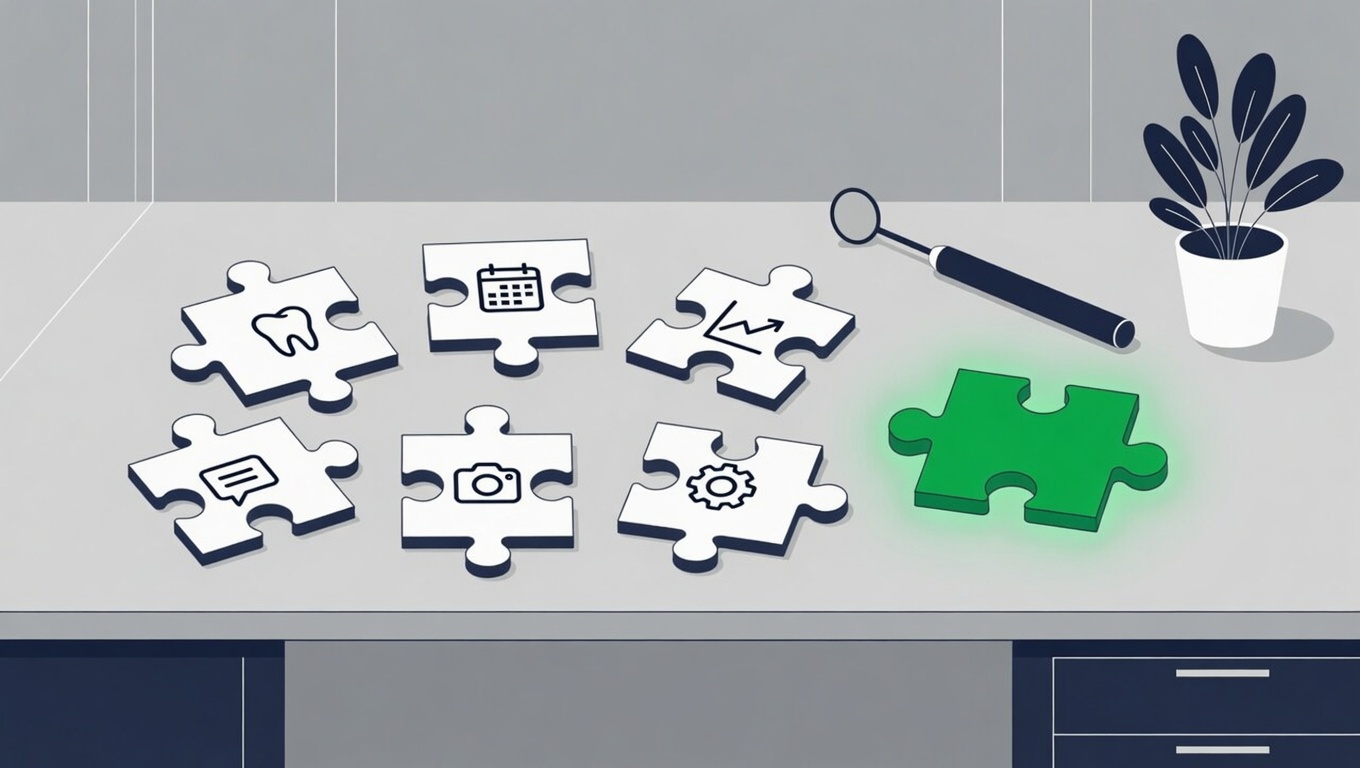
Here's a question I've never heard a good answer to: why does it take six different software subscriptions to run one dental practice?
You buy Dentrix for charting and scheduling. Then you buy Weave because Dentrix doesn't do patient texting well. Then you buy Dental Intelligence because neither Dentrix nor Weave gives you real analytics. Then you buy Yapi because your forms are still on paper. Then you need a clearinghouse for insurance claims. And you're probably paying for a support plan on top of all of it.
Six tools. Six logins. Six invoices. Six support teams that don't know what the other five are doing.
This isn't a technology problem. It's a business model problem.
How the dental software industry got here
The legacy PMS companies — Dentrix, Eaglesoft, Curve — were built in an era when "dental software" meant scheduling and charting. That's what they were designed to do, and for a long time, that was enough.
But as practices needed more — patient communication, digital forms, analytics, online booking, insurance automation — these legacy platforms didn't build those features. Instead, a wave of add-on companies emerged to fill the gaps.
Weave built patient texting. Dental Intelligence built analytics. Yapi built digital forms. Each one solving a real problem, but each one adding another monthly bill, another integration to maintain, and another vendor relationship to manage.
The result is an industry where the average dental practice pays $1,500-3,000/month (source) across multiple tools — and the tools still don't work together seamlessly.
What fragmentation actually costs you
The dollar amount is obvious. But fragmentation costs you in ways that don't show up on an invoice:
Staff time. Your front desk logs into three different systems throughout the day. Patient data lives in multiple places. When a patient calls, your team switches between Dentrix for the chart, Weave for the text history, and Dental Intelligence for the production data. That context-switching adds up to hours per week.
Data silos. Your PMS has the clinical data. Weave has the communication history. Dental Intelligence has the analytics. But none of them have the complete picture. Want to know which patients have unscheduled treatment AND haven't been contacted in 60 days? Good luck pulling that from three different dashboards.
Training burden. Every new hire needs to learn six different tools. Each one has its own interface, its own logic, its own quirks. Onboarding takes longer. Mistakes happen more often. And when someone leaves, their knowledge of how all six tools connect leaves with them.
Integration failures. The tools are "integrated" — but anyone who's used a Dentrix-Weave integration knows that "integrated" and "seamless" are not the same thing. Data syncs fail. Information gets stale. And when something breaks, each vendor points at the other one.
Why legacy vendors won't fix this
Dentrix could build patient texting. Weave could build charting. Dental Intelligence could build scheduling. But they won't — because fragmentation is profitable for everyone except the practice.
Dentrix doesn't need to build texting when they can partner with Weave and collect a referral fee. Weave doesn't need to build a PMS when their business model works as a $450/month add-on (source). And Dental Intelligence doesn't need to build either one when practices are willing to pay $350/month (source) for a dashboard that reads data from someone else's PMS.
The fragmented model works for the vendors. It doesn't work for you.
What "all-in-one" actually means
When we built Ayla, we didn't start with a PMS and bolt on add-ons. We started with a question: what does a dental practice actually need every day?
The answer was one system that handles:
- Clinical charting and treatment planning
- Multi-provider scheduling with automated reminders
- Two-way patient texting and missed call auto-text
- Digital forms with e-signature and auto-population
- Insurance verification, claims, and ERA posting
- Analytics, KPI dashboard, and provider scorecards
- Online booking and patient portal
- Mobile app with full clinical access
- Team chat and internal communication
- Payments — terminal, text-to-pay, payment plans
All of it in one platform. One login. One bill. One support team that knows the entire system.
Not because we're trying to do everything. Because these features should never have been separate products in the first place.
The math is simple
A practice running Dentrix + Weave + Dental Intelligence + a clearinghouse + Yapi + a support plan is paying $1,500-3,000/month.
Ayla replaces all of them for $499-999/month.
That's $10,000-26,000 per year back in your pocket — and a simpler workflow for your entire team.
Pricing estimates based on publicly available information and industry research as of 2026. Actual costs vary by practice size, contract terms, and features selected. Verify current pricing directly with each vendor.
See the full breakdown: How much does dental software really cost? or calculate your savings.
Dr. Ninus Ebrahimi
Founder, Ayla · Pediatric Dentist
Practicing pediatric dentist and founder of Ayla. Building the dental software he wished existed — one feature at a time.